
















Quick answer: Your puppy’s first vet visit should happen within the first week of bringing them home, usually at around 8 weeks of age. Expect a full nose-to-tail health check, a weigh-in, their first or second vaccination, worming and parasite prevention, a microchip scan, and a good long chat about food, toilet training, socialisation and what comes next. Allow 30 to 40 minutes.
Bringing a puppy home is a big deal, and the first vet visit can feel a bit like the first day of school: exciting, slightly nerve-racking, and full of questions you’re not sure you’re allowed to ask. You are. At Noah’s Ark in Medowie, the first visit is as much about you as it is about your puppy. Here’s what happens, what to bring, and how to make it a good experience for everyone, including the puppy.
When to book
Book within the first few days of your puppy arriving, even if the breeder or shelter has already given a vaccination. There are three good reasons:
- We want to confirm your puppy is healthy before you’ve fallen completely in love (we know, too late).
- Puppy vaccinations run on a schedule, and the gap between doses matters.
- The earlier a puppy learns the clinic is a place with treats and friendly people, the easier every future visit becomes.
Most puppies come home at eight weeks, so the first visit usually falls between eight and ten weeks of age.
What to bring
- Any paperwork from the breeder, shelter or pet shop: vaccination certificate, microchip details, worming history, and diet information.
- A fresh stool sample if you can manage it (a small sealed bag is fine). Intestinal worms are common in puppies and this lets us check.
- The food they’re currently eating, or at least the name of it, so we can talk about diet without guessing.
- A towel or blanket from home for the table. Familiar smells help.
- Small, soft treats. Lots of them.
- Your questions, written down. Everyone forgets at least one.
Carry your puppy in, or use a secure carrier. Until the vaccination course is complete, we’d rather they didn’t walk around the car park or waiting room floor.
What happens during the visit
The health check
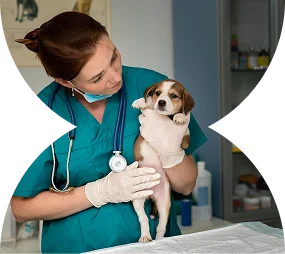
We’ll examine your puppy from nose to tail: eyes, ears, mouth and bite, heart and lungs, skin and coat, belly, joints and limbs, and the bits underneath. We’re checking for anything congenital (heart murmurs, hernias, retained testicles, cleft palate) as well as common puppy issues like ear mites, fleas and skin problems. We’ll also weigh them, which becomes the first point on a growth chart we’ll keep updating.
Vaccinations
Puppies need a course of vaccinations because the protection they get from their mother wears off gradually, and we can’t know exactly when. A typical course is given at around 6 to 8 weeks, 10 to 12 weeks and 14 to 16 weeks, covering parvovirus, distemper and hepatitis, with kennel cough added for most dogs. Parvovirus is still very much present in this region and is often fatal in unvaccinated puppies, so this part isn’t optional. Our vaccination page explains how we tailor the schedule to each puppy.
Worming and parasite prevention
Puppies should be wormed every two weeks until 12 weeks of age, then monthly until six months. We’ll check what’s been done and give the next dose if it’s due. We’ll also start talking about heartworm prevention and, because this is Port Stephens, paralysis tick prevention. Ticks are a year-round risk on this part of the coast and a serious one for a small puppy. See our flea and tick control page for options.
Microchip check
In NSW, puppies must be microchipped before sale or by 12 weeks, whichever comes first. We’ll scan the chip to confirm it reads and remind you to transfer the registration into your name on the NSW Pet Registry. A chip registered to the breeder won’t get a lost puppy home to you. If your puppy isn’t chipped yet, we can do it on the day. More on our microchipping page.
The conversation
This is where the real value is. Expect to cover:
- Food: how much, how often, and what to feed a growing puppy. Large breeds in particular need the right diet to protect developing joints. See our nutrition page.
- Toilet training and crate training, and what’s realistic at this age.
- Socialisation: the window for shaping a confident adult dog closes at around 14 to 16 weeks, so we’ll talk about how to safely expose your puppy to new people, sounds and surfaces before the vaccination course is finished.
- Desexing: timing varies by breed and size, and we’ll give you a recommendation for your puppy rather than a blanket rule. More on our desexing page.
- Pet insurance: worth considering early, before anything has a chance to become a pre-existing condition.
- Teething, nipping, chewing, sleeping and anything else keeping you up at night.
Making it a positive experience
We practise low-stress handling with every patient, and puppies are where it matters most. A puppy that gets fed treats on the exam table, gets to sniff the stethoscope, and leaves having had a nice time will walk in happily for the rest of its life. You can help by staying relaxed yourself (puppies read you closely), bringing treats, and not rushing. If your puppy seems overwhelmed, tell us. We’ll slow down.
What comes next
Before you leave we’ll book the next vaccination, usually three to four weeks away, and give you a written plan for worming and parasite prevention. After the final puppy vaccination, there’s typically a visit around six months for a desexing discussion, then annual health checks from there. Our article on how regular vet visits help your dog stay healthy covers what that looks like as your puppy grows up.



Puppy first vet visit FAQs
When should a puppy have its first vet visit?
Within the first week of coming home, usually at around eight weeks of age. Book it even if the breeder has already started vaccinations, so we can check the puppy over and keep the schedule on track.
How much does a puppy’s first vet visit cost?
It depends on what’s needed on the day, such as which vaccination is due, worming, and whether microchipping is required. Call us on (02) 4982 9899 and we’ll give you a clear idea before you book. We also offer payment options if that helps.
Can my puppy go outside before vaccinations are finished?
Yes, carefully. Your own backyard is fine if no unvaccinated dogs have been through it. Avoid parks, footpaths and dog beaches until a week or two after the final vaccination. You can still carry your puppy to new places to socialise them safely in the meantime.
What vaccinations does a puppy need in Australia?
Core vaccinations cover parvovirus, distemper and infectious hepatitis. Most dogs also receive kennel cough protection. The course is usually three doses between 6 and 16 weeks, followed by a booster at around 15 months.
Should I bring my puppy’s vaccination certificate?
Yes. It tells us exactly what’s been given and when, so we can continue the course correctly rather than repeating or skipping a dose.
Keep reading
- How Regular Vet Visits Help Your Dog Stay Healthy
- Understanding Your Cat’s Health and Behaviour
- Why Annual Health Checks Are Important for Cats
New puppy at home? The team at Noah’s Ark would love to meet them. We’ve been looking after the dogs of Medowie, Raymond Terrace, Salt Ash and Nelson Bay since 2002. Book a visit or call (02) 4982 9899.